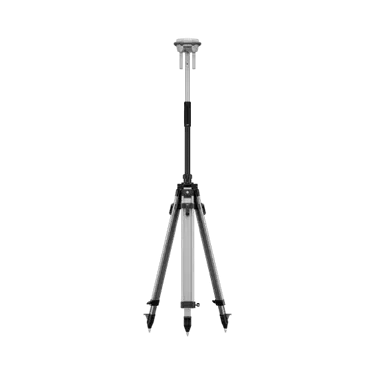
 Accessories
D-RTK 3 Multi-function Base Station
Multi-function base station integrating high-performance antennas and receiver modules. Tracks and processes data from global mainstream satellite navigation systems with support for multiple data transmission links. Functions as a base station for centimeter-level positioning, a repeater to extend operational range, or a rover mode for high-precision surveying.
Core Specifications
Product Video Introduction
Video sourced from the official DJI product page for reference.D-RTK 3 Multi-function Base Stationappearance and core functionality
* The video is an official DJI product video for reference on product form and features; actual configuration and pricing are subject to inquiry results.
Full Specifications
| Satellite Receive Frequency | GPS: L1C/A, L2C, L5; BDS: B1I, B2I, B3I, B1C, B2a, B2b; Galileo: E1, E5a, E5b, E6; GLONASS: L1, L2; QZSS: L1C/A, L2C, L5; L-BAND |
| System Precision | Base Station & Relay Station Modes Base Station Positioning Error: Single Point Accuracy (Uncalibrated): Horizontal: 1.5 m (RMS) Vertical: 3.0 m (RMS) GNSS Differential Accuracy: Convergence Time: 20 min Horizontal: 30 cm (RMS) Vertical: 40 cm (RMS) Network RTK Calibration: Horizontal: 1.0 cm (RMS) + 1 ppm Vertical: 3.0 cm (RMS) + 1 ppm Mobile Station Mode RTK Accuracy (Fixed Measurement): Horizontal: 0.8 cm (RMS) + 1 ppm Vertical: 1.5 cm (RMS) + 1 ppm RTK Accuracy (Tilted Measurement): Angle Range: 0° to 60° Horizontal: 8 mm + 0.7 mm/° tilt (Accuracy < 2 cm within 30°) Measurement accuracy depends on multiple factors. These values are achieved under normal conditions with clear sky visibility, optimal satellite distribution, quiet ionosphere, and no electromagnetic interference or multipath effects. Base station calibration coordinate accuracy depends on multiple factors. For surveying or high-precision flight missions, we recommend calibrating using a 4+ constellation Network RTK base station during periods of low ionospheric activity in open, unobstructed areas free from electromagnetic interference and multipath effects. |
| Satellite-based Differential | Supported frequencies: BDS B2b, GALILEO E6, L-BAND. Convergence time: 20 minutes. Horizontal accuracy: 30 cm (RMS). Vertical accuracy: 40 cm (RMS). Measurement accuracy depends on multiple factors; this value was measured under normal conditions with clear line-of-sight, optimal satellite distribution, low ionospheric activity, no electromagnetic interference, and minimal multipath effects. |
| Differential Data Transmission Format | When used as a base or relay station, record raw RTCM 3.2 observations in DAT format. In rover mode and base/relay calibration modes: 1. Supports RTCM v3.0, v3.1, v3.2, v3.3, MSM4, MSM5, MSM6, and MSM7 protocols. 2. Using four or more system mounts is recommended. |
| Initialize Reliability | >99.9% |
| Video Transmission · Video Transmission Solutions | O4 Video Transmission Industry Edition |
| Video Transmission · Operating Frequency | Repeater Mode: O4: 2.4 GHz/5.2 GHz/5.8 GHz Base Station Mode: O4: 2.4 GHz/5.8 GHz Rover Mode: BLE: 2.4 GHz Supported frequency bands and their available ranges vary by country/region. Please consult local regulations for details. |
| Video Transmission · EIRP | 2.4000 GHz to 2.4835 GHz: <33 dBm (FCC) <20 dBm (CE/SRRC/MIC) 5.150 GHz to 5.250 GHz: <23 dBm (CE/FCC) 5.725 GHz to 5.850 GHz: <33 dBm (FCC) <30 dBm (SRRC) <14 dBm (CE) |
| Video Transmission · Bluetooth | Protocol: Bluetooth 5.1 Operating Frequency: 2.400 GHz to 2.4835 GHz Transmit Power (EIRP): <10 dBm |
| Image Transmission · Maximum Signal Range Between Base Station and Rover (No Interference, No Obstruction) | Base Station Mode: 1. D-RTK 3 with Matrice 400: FCC: 40 km, SRRC/CE/JP: 20 km 2. D-RTK 3 with other aircraft: FCC: 15 km, SRRC: 12 km, CE/JP: 8 km Rover Mode: D-RTK 3 with mobile device: 30 m. The above data were measured in an open outdoor environment without interference. They represent the maximum communication distances for one-way flights without return-to-home under each standard. Please heed the app's return-to-home warnings during actual flight. |
| Image Transmission · Relay Mode: Maximum Effective Signal Range (No Interference, No Obstruction) | FCC: UAV-to-Relay Distance: 25 km; Relay-to-Remote Controller/DJI Airport 3 Distance: Recommended within 1 km, up to 3 km with no obstructions or interference. SRRC: UAV-to-Relay Distance: 12 km; Relay-to-Remote Controller/DJI Airport 3 Distance: Recommended within 1 km, up to 3 km with no obstructions or interference. CE: UAV-to-Relay Distance: 10 km; Relay-to-Remote Controller/DJI Airport 3 Distance: Recommended within 300 m, up to 1 km with no obstructions or interference. Before deploying the relay station, conduct a site survey. Interference or obstructions at the selected location can impair relay upgrades and log downloads. Choose an unobstructed, interference-free high-altitude location such as a rooftop or tower top for deployment. |
| Video Transmission · Maximum Signal Range (with interference, no obstruction) | Strong interference: Urban center, approx. 1.5 to 5 km Moderate interference: Suburban county area, approx. 5 to 15 km Minimal interference: Remote suburbs/coastal areas, approx. 15 to 25 km These data points were measured in line-of-sight conditions under typical interference levels per FCC standards. Actual flight distance is not guaranteed and should be used as a reference only. |
| Video Transmission · Maximum Effective Range (with interference and obstructions) | Minor interference with building obstruction: approximately 0 to 0.5 km Minor interference with tree obstruction: approximately 0.5 to 3 km These figures are measured under FCC standards in environments with obstructions and various typical levels of minor interference. Actual flight distance is not guaranteed; use for reference only during personal flights. |
| Image Transmission · Range Extension Effect of Repeater Station | Repeater Performance Boost: Severe Obstructions (e.g., buildings, mountains): 3x to 5x improvement. Light Obstructions (e.g., trees, glass): 1x to 3x improvement. Deploy the repeater at an elevated location free from interference and obstructions. |
| Video Transmission · Antenna | OcuSync 4 directional antenna × 4, 2 transmit / 4 receive, using standard reverse polarity SMA connectors |
| Electrical Characteristics · System Power Consumption | D-RTK 3 Multi-Functional Base Station: Repeater: 14.5 W, Reference Station: 7 W, Rover: 6.2 W. Maximum power consumption without heating; when powered via USB-C above 9 V with heating enabled in low temperatures, maximum power consumption is 36.5 W. D-RTK 3 Fixed Repeater Edition: Repeater: 14.5 W |
| Electrical Specifications · Power Interface | D-RTK 3 Multi-function Base Station: USB Type-C; D-RTK 3 Relay Station (Fixed Deployment): USB Type-C and Ethernet Port (PoE) |
| Electrical Characteristics · Power Support | D-RTK 3 Multi-function Base Station: USB PD 3.0 protocol; adapter with output voltage from 9 V to 15 V (e.g., DJI 6 5W Portable Charger). When using a non-recommended charger (e.g., with an output voltage of 5 V), charging is only supported when the device is powered off. D-RTK 3 Relay Station Fixed Deployment Edition: DJI Dock 3 PoE output port. Third-party PoE power supply: IEEE 802.3bt Type 4 (PoE++), output voltage from 52 V to 57 V, maximum output power 99.9 W; IEEE 802.3bt Type 3 (PoE++), output voltage from 50 V to 57 V, maximum output power 60 W; IEEE 802.3at Type 2 (PoE+), output voltage from 50 V to 57 V, maximum output power 30 W. |
| Electrical Specifications · Built-in Battery Runtime (Normal Temperature) | D-RTK 3 Multi-Function Base Station: Repeater: 4 hours, Base Station: 7 hours, Rover: 10 hours. D-RTK 3 Fixed Repeater Edition: Repeater: 4 hours. Battery life may decrease in low temperatures; use a power supply supporting USB PD 3.0. |
| Electrical Characteristics · Ethernet Cable Requirements | D-RTK 3 Multi-Function Base Station: Ethernet connection not supported. D-RTK 3 Relay Station (Fixed Deployment): Requires Cat 6 twisted-pair cable, length under 100 meters, with an outer diameter of 5.5 to 6.5 mm. |
| Electrical Characteristics · Battery | Type: Lithium-ion Battery | Capacity: 6500 mAh | Energy: 46.8 Wh |
| Physical Specifications · Operating Temperature | D-RTK 3 Multi-functional Base Station: -20°C to 55°C; D-RTK 3 Relay Station (Fixed Deployment Edition): -30°C to 55°C. 1. In normal temperatures, if the device shell temperature exceeds 48°C, charging power will be limited until the device cools down and full-power charging resumes. 2. After storing or using the device in low temperatures, move it to a normal environment and wait until the internal battery temperature rises above 0°C before charging. 3. After storing or using the device in high temperatures, move it to a normal environment and wait until the internal battery temperature drops below 45°C before charging. 4. When the D-RTK 3 Relay Station (Fixed Deployment Edition) is connected to a PoE power source of Type 4, it supports heating for cold-start operation. |
| Physical Characteristics · Altitude | 6000 meters |
| Physical Properties · Protection Performance | D-RTK 3 Multi-function Base Station: IP67; D-RTK 3 Relay Station Fixed Edition: IP67. Follow the requirements specified for the IP67 rating. These ratings were measured under controlled conditions and are not permanent; protection may degrade due to product wear. Ensure all rubber plugs on the chassis and the heat dissipation plate of the DJI Enhanced Transmission module are properly installed. |
| Physical Characteristics · Drop Resistance | D-RTK 3 Multi-Frequency Base Station: 2 Meter Drop from Pole |
| Physical Characteristics · Dimensions | D-RTK 3 Multi-Function Base Station: Φ 163 mm × 89 mm (excluding OcuSync directional antenna). D-RTK 3 Relay Station (Fixed Deployment): Φ 163 mm × 344 mm. |
| Physical Properties · Weight | D-RTK 3 Multi-function Base Station: approx. 1.26 kg; D-RTK 3 Relay Station (Fixed Deployment Edition): approx. 2.24 kg |
* Specifications are sourced from DJI's official product page; actual configurations may vary by factory. Prices are subject to inquiry.
Download Product Brochure
Below isD-RTK 3 Multi-function Base StationProduct Brochure Preview: Click the button to generate and download a PDF version for internal review and selection archiving.
Multi-function base station integrating high-performance antennas and receiver modules. It tracks and processes data from global mainstream satellite navigation systems and supports multiple data transmission links. Functions as a base station for centimeter-level positioning, acts as a repeater to extend operational range, and supports rover mode for high-precision aerial surveying.
| Satellite Receive Frequency | GPS: L1C/A, L2C, L5; BDS: B1I, B2I, B3I, B1C, B2a, B2b; Galileo: E1, E5a, E5b, E6; GLONASS: L1, L2; QZSS: L1C/A, L2C, L5; L-BAND |
| System Precision | Base Station & Relay Station Modes Base Station Positioning Error: Single Point Accuracy (Uncalibrated): Horizontal: 1.5 m (RMS) Vertical: 3.0 m (RMS) GNSS Differential Accuracy: Convergence Time: 20 min Horizontal: 30 cm (RMS) Vertical: 40 cm (RMS) Network RTK Calibration: Horizontal: 1.0 cm (RMS) + 1 ppm Vertical: 3.0 cm (RMS) + 1 ppm Mobile Station Mode RTK Accuracy (Fixed Measurement): Horizontal: 0.8 cm (RMS) + 1 ppm Vertical: 1.5 cm (RMS) + 1 ppm RTK Accuracy (Tilted Measurement): Angle Range: 0° to 60° Horizontal: 8 mm + 0.7 mm/° tilt (Accuracy < 2 cm within 30°) Measurement accuracy depends on multiple factors. These values are achieved under normal conditions with clear sky visibility, optimal satellite distribution, quiet ionosphere, and no electromagnetic interference or multipath effects. Base station calibration coordinate accuracy depends on multiple factors. For surveying or high-precision flight missions, we recommend calibrating using a 4+ constellation Network RTK base station during periods of low ionospheric activity in open, unobstructed areas free from electromagnetic interference and multipath effects. |
| Satellite-based Differential | Supported Frequencies: BDS B2b, GALILEO E6, L-BAND Convergence Time: 20 minutes Horizontal Accuracy: 30 cm (RMS) Vertical Accuracy: 40 cm (RMS) Measurement accuracy depends on multiple factors. This value is achieved under optimal conditions: open sky with no obstructions, favorable satellite geometry, quiet ionosphere, no electromagnetic interference, and minimal multipath effects. |
| Differential Data Transmission Format | When used as a base or relay station, record RTCM 3.2 raw observation data in DAT format. In rover mode and in base/relay calibration modes: 1. Supports RTCM v3.0, v3.1, v3.2, v3.3, MSM4, MSM5, MSM6, and MSM7 protocols. 2. Using four or more systems is recommended. |
| Initialize Reliability | >99.9% |
| Video Transmission · Video Transmission Solutions | O4 Transmission Industry Edition |
| Video Transmission · Operating Frequency | Repeater Mode: O4: 2.4 GHz/5.2 GHz/5.8 GHz Base Station Mode: O4: 2.4 GHz/5.8 GHz Rover Mode: BLE: 2.4 GHz Supported frequency bands and their available ranges vary by country/region. Please refer to local laws and regulations for details. |
| Video Transmission · EIRP | 2.4000 GHz to 2.4835 GHz: <33 dBm (FCC), <20 dBm (CE/SRRC/MIC) 5.150 GHz to 5.250 GHz: <23 dBm (CE/FCC) 5.725 GHz to 5.850 GHz: <33 dBm (FCC), <30 dBm (SRRC), <14 dBm (CE) |
| Video Transmission · Bluetooth | Protocol: Bluetooth 5.1 Operating Frequency: 2.400 GHz to 2.4835 GHz Transmit Power (EIRP): <10 dBm |
| Image Transmission · Maximum Signal Range Between Base Station and Rover (No Interference, No Obstruction) | Base Station Mode: 1. D-RTK 3 with Matrice 400: FCC: 40 km, SRRC/CE/JP: 20 km 2. D-RTK 3 with other aircraft: FCC: 15 km, SRRC: 12 km, CE/JP: 8 km Rover Mode: D-RTK 3 with mobile device: 30 m. These data were measured in an open outdoor environment without interference and represent the maximum one-way flight distance (without return) under each standard. Please monitor the app's return-to-home alerts during actual flights. |
| Image Transmission · Relay Mode: Maximum Effective Signal Range (No Interference, No Obstruction) | FCC: Aircraft-to-Relay distance: 25 km; Relay-to-Remote Controller/DJI Airport 3 distance: Recommended within 1 km; up to 3 km in open, interference-free conditions. SRRC: Aircraft-to-Relay distance: 12 km; Relay-to-Remote Controller/DJI Airport 3 distance: Recommended within 1 km; up to 3 km in open, interference-free conditions. CE: Aircraft-to-Relay distance: 10 km; Relay-to-Remote Controller/DJI Airport 3 distance: Recommended within 300 m; up to 1 km in open, interference-free conditions. The relay site must be surveyed prior to deployment. If interference or obstructions at the selected location result in poor signal quality, relay firmware upgrades and log downloads may fail. Deploy at elevated, unobstructed locations such as rooftops or tower tops with minimal interference. |
| Video Transmission · Maximum Signal Range (with interference, no obstruction) | Strong Interference: Urban center, approx. 1.5 to 5 km Moderate Interference: Suburban/county area, approx. 5 to 15 km Minimal Interference: Remote suburbs/coastal areas, approx. 15 to 25 km These figures were measured in FCC-compliant environments with no obstructions under typical interference conditions. Actual flight distance is not guaranteed and should be used as a reference only. |
| Video Transmission · Maximum Effective Range (with interference and obstructions) | Minor interference with building obstruction: approximately 0 to 0.5 km Minor interference with tree obstruction: approximately 0.5 to 3 km These data were measured under FCC standards in environments with obstructions and various typical levels of minor interference. Actual flight distance is not guaranteed; use for reference only during your own flights. |
| Image Transmission · Range Extension Effect of Repeater Station | Relay Station Performance Boost: Resolves severe obstructions (e.g., buildings, mountains): 3x to 5x performance improvement. Resolves minor obstructions (e.g., trees, glass): 1x to 3x performance improvement. Deploy relay stations at elevated locations free from interference and obstructions. |
| Video Transmission · Antenna | OcuSync 4 directional antenna × 4, 2 transmit / 4 receive, using standard reverse polarity SMA connectors |
| Electrical Characteristics · System Power Consumption | D-RTK 3 Multi-function Base Station: Repeater: 14.5 W, Base Station: 7 W, Rover: 6.2 W. Maximum power consumption without heating; when connected to a USB-C power source above 9 V, maximum power consumption with low-temperature heating enabled is 36.5 W. D-RTK 3 Repeater (Fixed Deployment Edition): Repeater: 14.5 W |
| Electrical Specifications · Power Interface | D-RTK 3 Multi-Function Base Station: USB Type-C D-RTK 3 Relay Station (Fixed Deployment): USB Type-C and Ethernet Port (PoE) |
| Electrical Characteristics · Power Support | D-RTK 3 Multi-Function Base Station: USB PD 3.0 protocol, adapter with output voltage 9 V to 15 V (e.g., DJI 6 5W Portable Charger). When using a non-recommended charger (e.g., output voltage 5 V), charging is supported only when the device is powered off. D-RTK 3 Relay Station Fixed Deployment Version: DJI Dock 3 PoE output port. Third-party PoE power supply: IEEE 802.3bt Type 4 (PoE++), output voltage 52 V to 57 V, max output power 99.9 W; IEEE 802.3bt Type 3 (PoE++), output voltage 50 V to 57 V, max output power 60 W; IEEE 802.3at Type 2 (PoE+), output voltage 50 V to 57 V, max output power 30 W. |
| Electrical Specifications · Built-in Battery Runtime (at Room Temperature) | D-RTK 3 Multi-function Base Station: Relay Station: 4 hours, Reference Station: 7 hours, Rover: 10 hours. D-RTK 3 Relay Station Fixed Deployment Edition: Relay Station: 4 hours. In low temperatures, battery life may decrease; use a power source supporting the USB PD 3.0 protocol. |
| Electrical Characteristics · Ethernet Cable Requirements | D-RTK 3 Multi-Function Base Station: Ethernet connection not supported. D-RTK 3 Relay Station (Fixed Deployment): Requires Cat 6 twisted-pair cable, length under 100 meters, with an outer diameter of 5.5 to 6.5 mm. |
| Electrical Specifications · Battery | Type: Lithium-ion Battery | Capacity: 6500 mAh | Energy: 46.8 Wh |
| Physical Specifications · Operating Temperature | D-RTK 3 Multi-functional Base Station: -20°C to 55°C D-RTK 3 Relay Station (Fixed Deployment): -30°C to 55°C 1. In normal ambient conditions, charging power is limited if the device shell temperature exceeds 48°C. Full-power charging resumes once cooled. 2. After storage or use in low temperatures, move the device to a normal environment and wait until the internal battery temperature rises above 0°C before charging. 3. After storage or use in high temperatures, move the device to a normal environment and wait until the internal battery temperature drops below 45°C before charging. 4. When connected to a Type 4 PoE power supply, the D-RTK 3 Relay Station (Fixed Deployment) supports heating for cold-start capability. |
| Physical Characteristics · Altitude | 6000 meters |
| Physical Properties · Protection Performance | D-RTK 3 Multi-function Base Station: IP67 D-RTK 3 Relay Station Fixed Deployment Version: IP67. Adhere to the requirements specified in the IP67 protection rating documentation. Measured under controlled conditions; protection ratings are not permanent standards and may degrade due to product wear. Ensure all rubber plugs, ports, and DJI Enhanced Video Transmission module heat sinks are properly installed. |
| Physical Characteristics · Drop Resistance | D-RTK 3 Multi-Frequency Base Station: 2 Meter Drop from Pole |
| Physical Characteristics · Dimensions | D-RTK 3 Multi-Function Base Station: Φ 163 mm × 89 mm (excluding OcuSync directional antenna) D-RTK 3 Relay Station Fixed Deployment Edition: Φ 163 mm × 344 mm |
| Physical Properties · Weight | D-RTK 3 Multi-function Base Station: ~1.26 kg D-RTK 3 Relay Station (Fixed Deployment): ~2.24 kg |
Brochures are generated in real-time from page content. If your browser blocks the download, allow pop-ups and try again.
- Professional Scenario Selection Guide
- Customer Service Hotline 4006068166
- Building 7, Compound 2, Guanghua Road, Chaoyang District, Beijing
Purchase Intent
Submit your requirements and contact details. A sales consultant will confirm pricing, stock availability, and delivery options with you. Product prices are subject to quotation.